
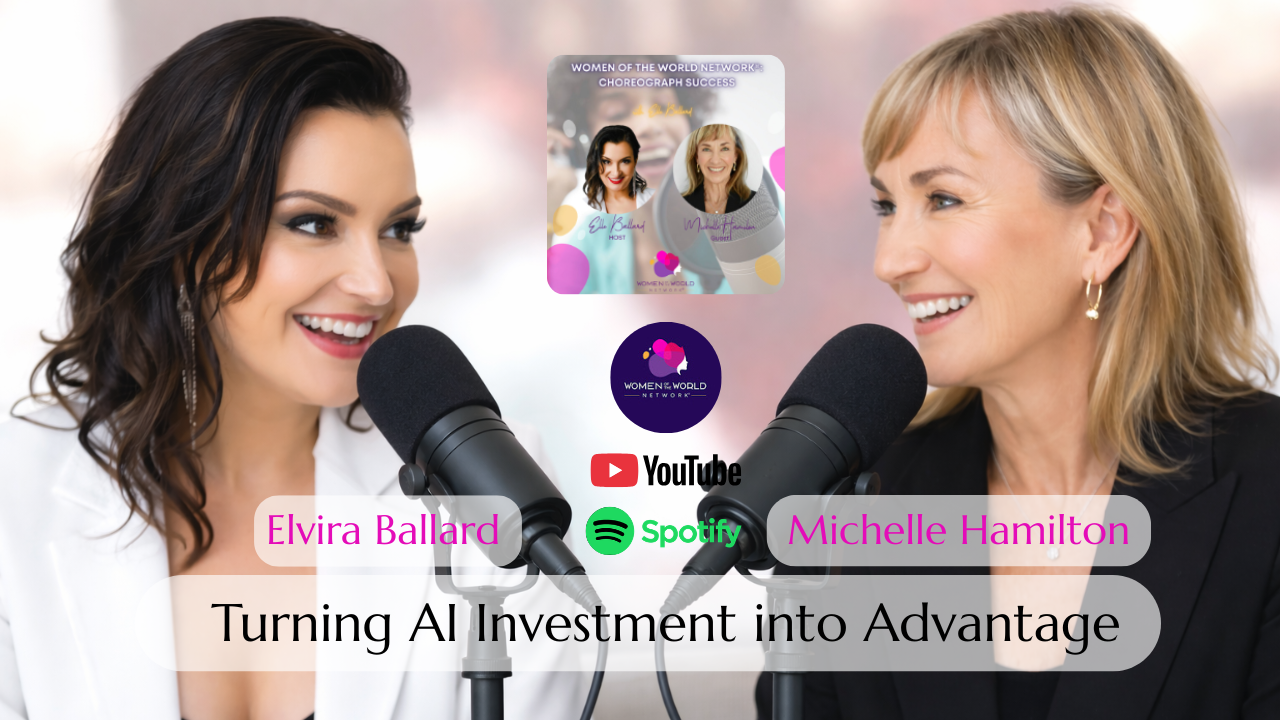
Turning AI Investment into Advantage Podcast Episode with Elvira Ballard on Women of The World Network® Choreograph Success
A Conversation with Elle Ballard on the Women of the World Network Choreograph Success Podcast
There are conversations that feel timely, and then there are conversations that feel necessary. My recent time with Elle Ballard on the Women of the World Network Choreograph Success podcast was the second kind.
We talked about AI, yes, but not in the way most AI conversations happen right now. Not as a product update. Not as a wave of hype. Not as a race to adopt the newest tool.
Instead, Elle created space for something more human: a conversation about what happens when technology moves faster than organizations, and what leaders can do to close the gap.
The episode was titled “Turning AI Investment into Advantage,” and that phrase captures the heart of what Spark AI Strategy exists to solve. Most organizations are not struggling to access AI. They are struggling to implement it in a way that actually changes daily work, protects their people, and produces measurable outcomes.
From glassblowing to the built environment, to AI
Elle began by asking about my path, because on paper it looks unexpected. I started out as a glass artist. I have a master’s degree in glass blowing, and my work has lived in museums and permanent collections around the world.
That chapter of my life might seem far from commercial real estate or AI, but it actually created the bridge.
Many of the people commissioning my work were architects, designers, and construction firms. That work pulled me into the built environment, and over time, I found myself drawn to the business side, the strategy side, and the connective tissue between teams.
That eventually became three decades in commercial real estate and AEC. And when AI arrived, it landed in a space I already understood deeply, not as a tech trend, but as something that would reshape how firms make decisions, coordinate work, and preserve institutional knowledge.
The early moment that changed everything
I shared something on the podcast that still makes me smile: my son introduced me to an early version of ChatGPT before most of the world had heard of it. For months, we experimented together, and I started applying it to architectural practice, business development, and marketing.
Even then, the core question wasn’t “What can this tool do?”
It was “How can teams use this safely, responsibly, and in a way that actually helps people do their work better?”
That question is still the foundation of my methodology today.
The pivot that became Spark AI Strategy
Elle asked about the “next level” moment, the pivot that opened the door to what I’m doing now. For me, it came after a layoff, during one of those economic shifts that commercial real estate knows all too well.
What could have been a destabilizing experience became an unexpected gift of time. I had a few weeks to get quiet, to be with family, and to reflect on what I wanted to build. I have a long meditation practice, and I used that season to write, think, and map a vision.
During that time, Spark AI Strategy took shape.
I wrote the plan, named the company, and gave myself a month to stand it up. And while that timeline might sound intense, it was made possible by something I now teach and model: when you can orchestrate support correctly, you can move faster without sacrificing quality.
I often say I have an “army of AI bots” working alongside me, because AI can accelerate execution when it is used with clarity. But the emphasis is always the same. AI amplifies the human. It does not replace the human.
What I see inside organizations right now
The most important part of our conversation was Elle asking what I see happening in companies today as they adopt AI across departments.
This is the reality I see most often:
Organizations invest in tools.
They deploy licenses.
They announce a rollout.
And then adoption becomes uneven.
Some teams embrace it.
Some avoid it.
Some use it quietly without guardrails.
Some feel intimidated, watched, or unsure how to start.
The result is predictable: leaders start asking questions about ROI, risk, and accountability.
This is the adoption gap.
And the adoption gap is not primarily a technology problem. It is a leadership and enablement problem.
Why AI must be implemented bottom-up and led top-down
One of the core ideas I shared on the podcast is that AI is not implemented the way most software is implemented.
Traditional enterprise rollouts assume a top-down model: leadership chooses the platform, IT deploys it, and the organization adapts.
AI does not work like that.
AI adoption is a bottom-up integration that requires top-down leadership.
Leadership and IT absolutely must define privacy, security, governance, and tooling standards. But the use cases, the value, the real adoption lives inside the work.
The fastest path to adoption is sitting with the people doing the work and asking:
What are your deliverables?
What are your KPIs?
Where is your time going?
What is repetitive, manual, draining, or error-prone?
Where do you need clarity, not just speed?
When teams feel heard, when they feel psychologically safe, when the work is framed in their language, fear drops and curiosity rises. And that is where adoption begins.
The role of communication in better AI outcomes
Another point I emphasized is that AI responds best when humans communicate clearly.
If you can speak, if you can describe what you need, if you can articulate context and even emotion behind a project, AI performs better.
This is why generic prompting often disappoints people. The tool is not judging you. It is responding to how the work is framed.
When leaders teach teams how to frame requests, not just how to use features, confidence grows, and the output quality changes.
Why an organization needs unified AI intellectual property
Elle also surfaced something I care about deeply: organizations need to treat AI adoption as an IP-building moment.
The best firms are not just “using AI.” They are capturing their best thinking.
That is why we teach clients how to build an IP-based prompt library: a shared system of prompts, frameworks, and workflows that reflects how the organization operates.
This does two things:
It reduces siloed learning and reinvention.
It preserves tribal knowledge and spreads capability across teams.
Over time, that library becomes an internal asset, not just a tool habit.
Why IT cannot carry this alone
We also talked about the reality that AI rollouts often land on the IT department’s shoulders. IT is essential, and the job of protecting the organization matters.
But most IT teams are not built to carry change management, emotional resistance, and communication training across the workforce.
This is where a human-first approach becomes powerful.
When business leadership, operations, and IT are aligned, the rollout becomes both protected and adoptable. The company stays secure, and the workforce feels equipped instead of policed.
What “choreographing success” means in 2026
Elle’s podcast is called Choreograph Success, and that theme fits AI adoption perfectly. AI adoption must be choreographed. It must be architected. It must be implemented with intention.
For me, success right now looks like “Michelle 2.0.”
Many of my peers are thinking about retirement. I’m building something new. And I love the idea that AI is not reserved for the young, or the technical, or the early adopters.
AI is for everyone who is willing to rethink how they work, and who is willing to trust themselves through the learning curve.
One of the most meaningful moments in the episode was talking about future generations. I’m a grandmother. When I think about what my grandson will normalize, I want him to see that growth does not have an expiration date. Reinvention is allowed. Building is allowed. Curiosity is allowed.
A simple invitation: have fun with it
As we closed the episode, Elle asked what message I would leave with listeners.
My answer was simple: have fun with AI.
I know AI can feel intimidating. But if you can approach it with curiosity, even in small ways, you begin to see what it can do for you. I even taught my mother to use AI in voice mode as a sous chef in the kitchen. It helps her cook. They talk back and forth. It makes learning feel light.
AI gives you access to more knowledge than ever before. But you are still the human. You are still the creative force. You are still the decision-maker.
AI should serve you, not replace you.
Listen to the episode and explore what we build
I’m grateful to Elle Ballard and the Women of the World Network for the conversation, and for creating a platform that centers leadership, possibility, and real-world transformation.
If you want to learn more about Spark AI Strategy and how we help organizations turn AI investment into adoption and measurable advantage, you can explore our updated website at sparkaistrategy.com.
And if you are a leader trying to move from tool ownership to operational capability, the best place to start is clarity.
Not another license.
Not another platform.
Not another pilot.
Clarity.
Because AI doesn’t fail organizations.
Implementation does.

The End of the Gantt Chart Guessing Game? How AI is Building the Future of Construction Schedules.
What if your project timeline wasn’t just a best guess, but a data-driven certainty? Imagine a wor

Walmart Prepares for AI Shopping Agents Revolution
Walmart is adapting to a transformative shift in consumer behavior driven by the rise of AI shopping

Powering the Future of CRE: AI Data Center Boom Ignites New Opportunities in Commercial Real Estate
The relentless march of artificial intelligence is not only reshaping industries but also creating e