

Your 2027 AI Plan Shouldn’t Start With a Budget. It Should Start With These 5 Questions.
It's early November. Somewhere in your organization, someone is building the 2027 AI budget.
Before that number gets approved, there are five questions worth answering. If you can't answer them clearly, more budget won't fix the problem. It will just buy more of what you already have.
Why the budget conversation comes too early
Budget season creates its own momentum. Numbers are due, plans are expected, and AI is on everyone's list. So the conversation jumps straight to how much to spend, and skips what the spending is supposed to change.
That's how companies end up with a second year of licenses for tools that a fraction of the team uses, and a plan to buy more to make up for it.
The five questions
You don't need a consultant to answer these. You need an honest conversation with the people who run the work:
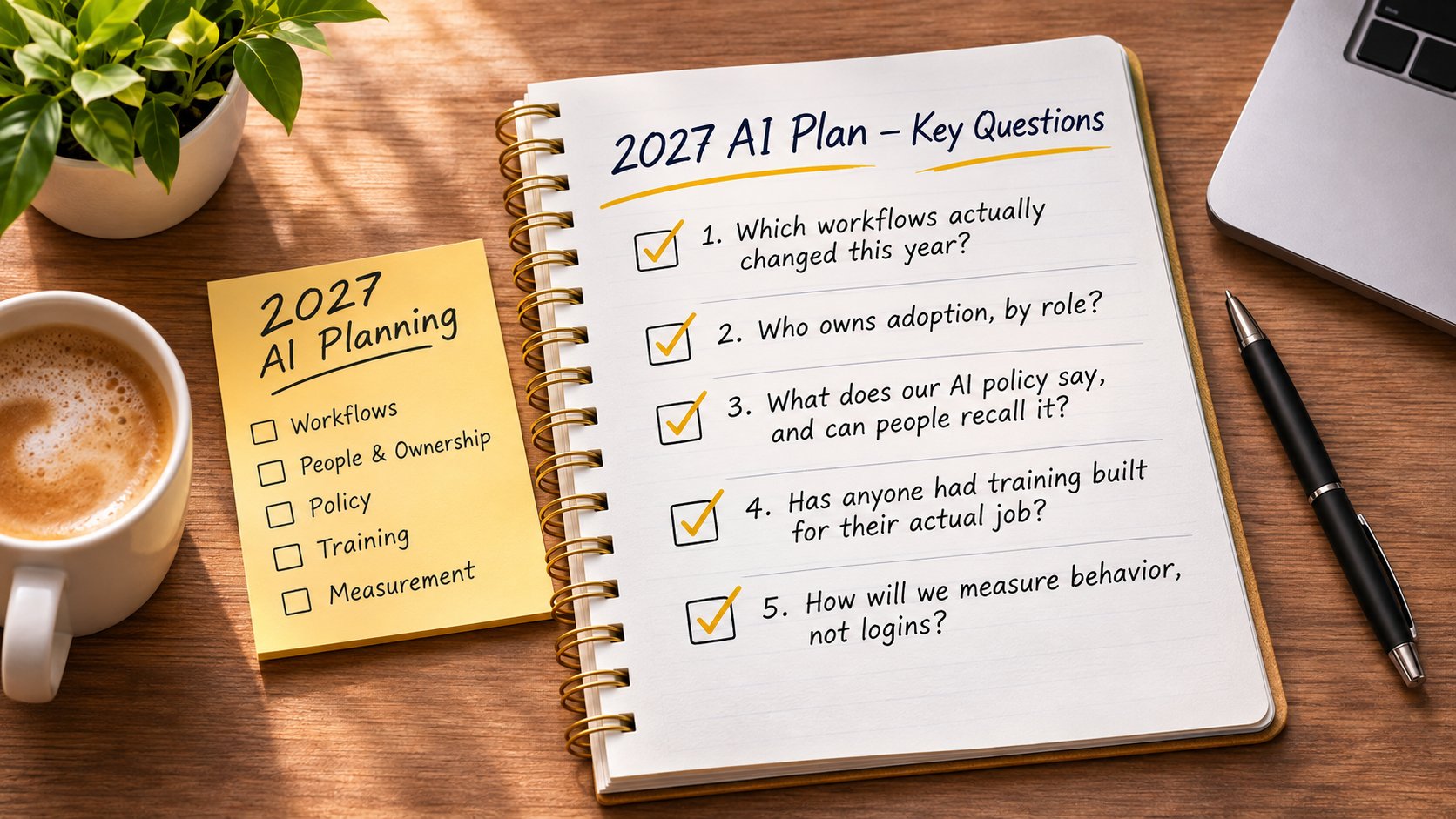
Which workflows actually changed this year?
Name them. "We rolled out the tools" isn't an answer. "Our weekly reports are now drafted with AI and reviewed by a person" is. If the list is short or empty, that's the most important thing to know.
Who owns adoption, by role?
Not whoever volunteered first. A named role with real authority, time, and a clear handoff if the person changes. If ownership lives in one person's head, it won't survive a busy quarter.
What does our written AI policy say, and can people recall it?
A policy nobody reads isn't a policy. Ask three people what's allowed and what isn't. If the answers differ, people are either holding back or guessing.
Has anyone had training built for their actual job?
A general overview isn't the same thing. Role-specific practice, on real work, is what builds the confidence that turns access into use.
How will we measure behavior, not logins?
Decide now which workflows should change in 2027 and what you'll track inside them. Without that, next year's report will tell you who opened the tool, not what changed.
What to do with your answers
Every gap points to a specific stage of adoption, and each stage has a different fix. A policy gap needs a one-page document. A capability gap needs training. A behavior gap needs a workflow with an owner.
Start with the cheapest gap to close, not the most exciting one. Fixing the basics usually unlocks value from tools you already own, and that changes how much new spending you actually need.
The test that tells you if you're ready to spend
If you can't answer most of these five questions clearly, next year's budget is a bet, not a plan.
That isn't a reason to freeze spending. It's a reason to put part of the budget toward the skills and structure that make the rest of it work.
Where this fits in the bigger picture
Most AI rollouts stall somewhere in the middle of the journey, not at the start. Access is usually solved. The gaps sit in permission, capability, and behavior, and those are the ones a budget line alone can't close.
If you're planning for 2027 right now, the questions above are worth an hour before the numbers are final.
Build the skills before you scale the spend
Join the free AI training and get a month of Claude license to put what you learn to work right away.
Get the Free AI Training →
You Bought the AI Tools. So Why Isn’t Anyone Using Them?
The Diagnosis Piece · Why Adoption Stalls A team buys an AI tool. Leadership checks the box: done.

Workflow First, AI Second
Most AI initiatives start with a tool. Someone finds something impressive, brings it back to the tea

AI Didn’t Fail. Your Operating Model Did.
Why adoption problems are usually organizational, not technological. When an AI rollout goes quiet,