
The End of AI Tools: Why the Next Phase Is AI Systems
AI Is No Longer the Competitive Advantage
Just a few years ago, access to AI felt like an advantage.
Organizations rushed to purchase licenses, experiment with new platforms, and explore what artificial intelligence could do for their business. Early adopters gained attention simply by being first.
Today, that advantage has disappeared.
The same AI models are available to nearly everyone. Whether you’re using Microsoft Copilot, ChatGPT Enterprise, Google Gemini, Claude, or another platform, the technology itself is becoming increasingly accessible.
The question is no longer:
“What AI tools are you using?”
The better question is:
“How does your business operate differently because of them?”
That shift marks the beginning of the next phase of AI.
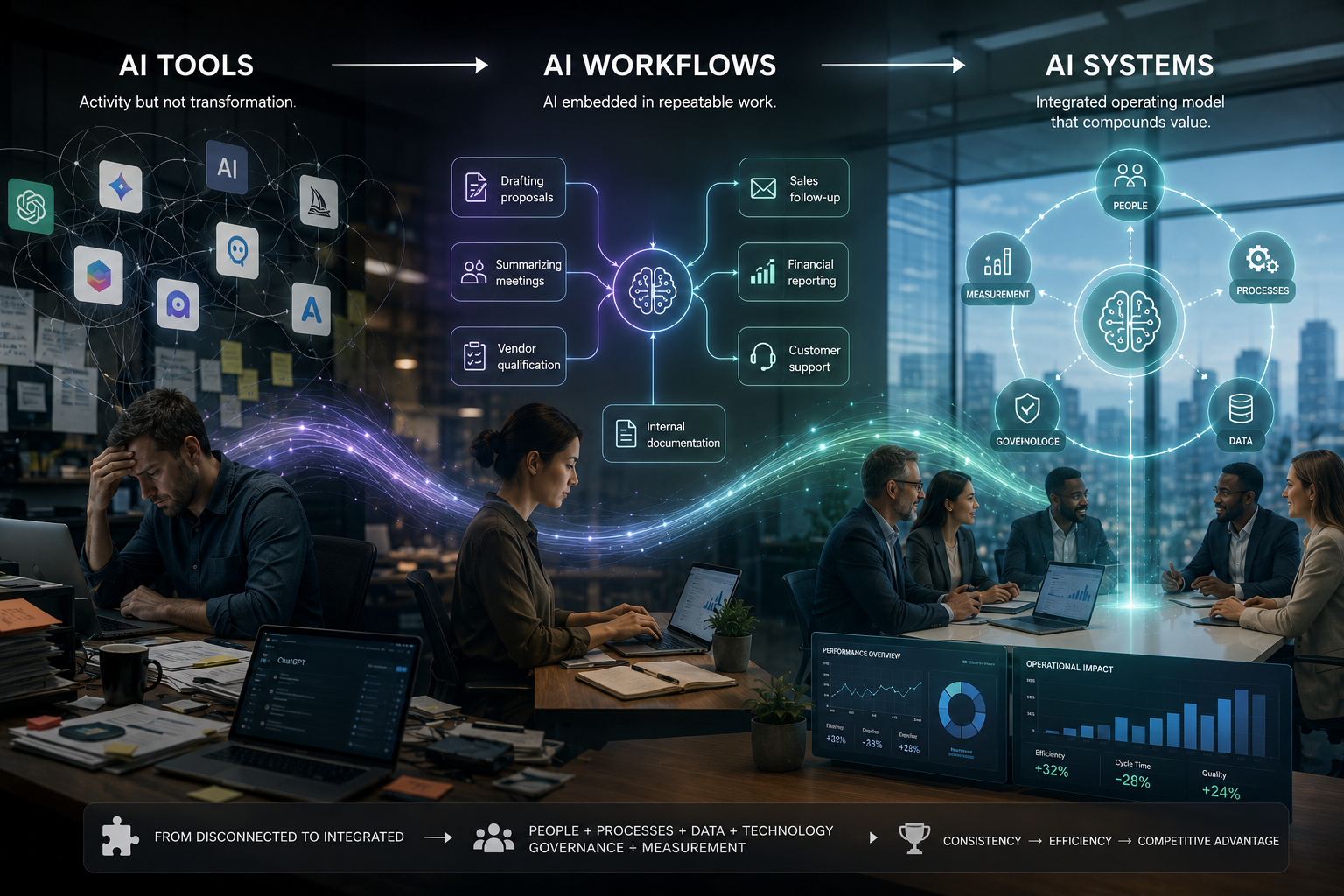
We are moving from tools to systems.
The AI Tool Trap
Many organizations are still approaching AI the same way they approached software over the last twenty years.
The process usually looks something like this:
- Leadership approves the investment.
- IT evaluates vendors.
- Licenses are purchased.
- Training sessions are scheduled.
- Employees receive access.
Then everyone waits for productivity gains to appear.
Sometimes they do.
More often, they don’t.
Not because the technology failed.
Because the organization never changed.
AI cannot transform a business if it is simply added on top of existing processes.
Without redesigning how work actually happens, AI becomes another application employees occasionally open instead of an operational capability they rely on every day.
The Three Stages of AI Maturity
Organizations typically evolve through three stages.
Stage 1 — AI Tools
This is where most businesses are today.
Employees experiment with prompts.
Departments purchase different platforms.
Individuals discover useful shortcuts.
The organization celebrates adoption because licenses are being used.
This stage creates activity.
It rarely creates transformation.

Stage 2 — AI Workflows
The next step isn’t buying another tool.
It’s redesigning repeatable work.
Instead of asking:
“What else can AI do?”
Leading organizations ask:
“Where does repetitive work slow our people down?”
This changes everything.
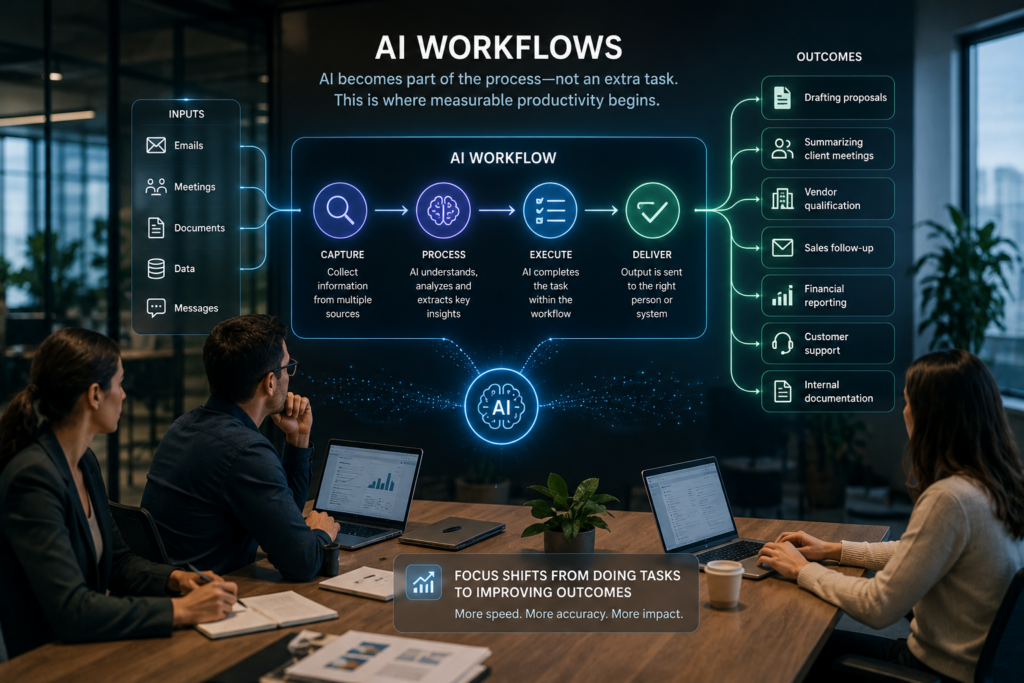
Instead of random experimentation, AI becomes embedded inside specific workflows.
Examples include:
- Drafting proposals
- Summarizing client meetings
- Vendor qualification
- Sales follow-up
- Financial reporting
- Customer support
- Internal documentation
AI becomes part of the process—not an extra task.
This is where measurable productivity begins.
Stage 3 — AI Systems
This is where the biggest competitive advantage will be created over the next several years.
An AI system is not one tool.
It is an interconnected operating model.
People.
Processes.
Data.
Technology.
Governance.
Measurement.
All working together.
Instead of asking employees to remember when to use AI, the organization designs workflows where AI naturally supports the work being done.
The result is consistency.
Consistency becomes efficiency.
Efficiency compounds into competitive advantage.

Why Buying More AI Tools Won't Solve the Problem
One of the most common patterns we see is organizations responding to disappointing adoption by purchasing another platform.
The assumption is:
“Maybe we just chose the wrong tool.”
In reality, the problem usually has nothing to do with technology.
The questions that matter are different:
- Who owns AI adoption?
- Which workflows should change first?
- How will success be measured?
- What behaviors need to change?
- Where does AI remove friction rather than add it?
Without answering these questions, every new tool simply increases complexity.
More licenses.
More platforms.
More confusion.
Technology becomes fragmented.
Employees become overwhelmed.
Leadership begins questioning the return on investment.
The issue isn’t capability.
It’s coordination.
Systems Create Compounding Value
The organizations seeing meaningful AI results have something in common.
They think in systems.
Instead of isolated wins, they build repeatable ways of working.
A sales conversation automatically creates meeting notes.
Those notes generate follow-up emails.
Customer insights update the CRM.
The CRM informs future proposals.
Leadership dashboards update automatically.
Nothing happens in isolation.
Every workflow feeds the next.
This is where AI stops feeling like software.
It becomes part of the organization’s operating system.
The Human Side of Systems
Technology alone has never transformed an organization.
People do.
Employees need clarity.
Managers need ownership.
Leadership needs measurable outcomes.
Governance needs to support—not restrict—innovation.
The businesses that succeed with AI don’t simply train employees how to use a platform.
They redesign work around people.
That is the difference between adoption and transformation.
The Future Belongs to Systems Thinkers
The conversation around AI has matured.
The winners won’t be the organizations with the largest AI budget.
They won’t be the ones testing the most tools.
They will be the organizations that intentionally redesign how work flows from one person, one team, and one department to the next.
Because tools can be copied.
Systems cannot.
A well-designed AI operating system becomes part of your competitive advantage.
It reflects your people, your processes, your knowledge, and your culture.
That is much harder to replicate than a software license.
Final Thought
The AI race is no longer about access.
It’s about integration.
The companies that continue collecting tools will continue collecting complexity.
The companies that build AI systems will build organizations that are faster, more adaptive, and better prepared for the future.
The next phase of AI isn’t another platform.
It’s a better way of working.