
Google Gemini 3.8 Live Is More Than Voice AI. It’s a Workflow Shift
Google’s new Gemini Live models are another sign that AI is moving away from static chat boxes and into the live moments where work actually happens.
For the last few years, most people have experienced AI through a text box.
You type a question. The model gives an answer. You refine the prompt. It responds again.
That interaction changed how many people work, but it still kept AI in a familiar shape: a tool you open, type into, and wait on.
Google’s new Gemini 3.8 Live models point toward a different kind of interaction.
Not just chat.
Conversation.
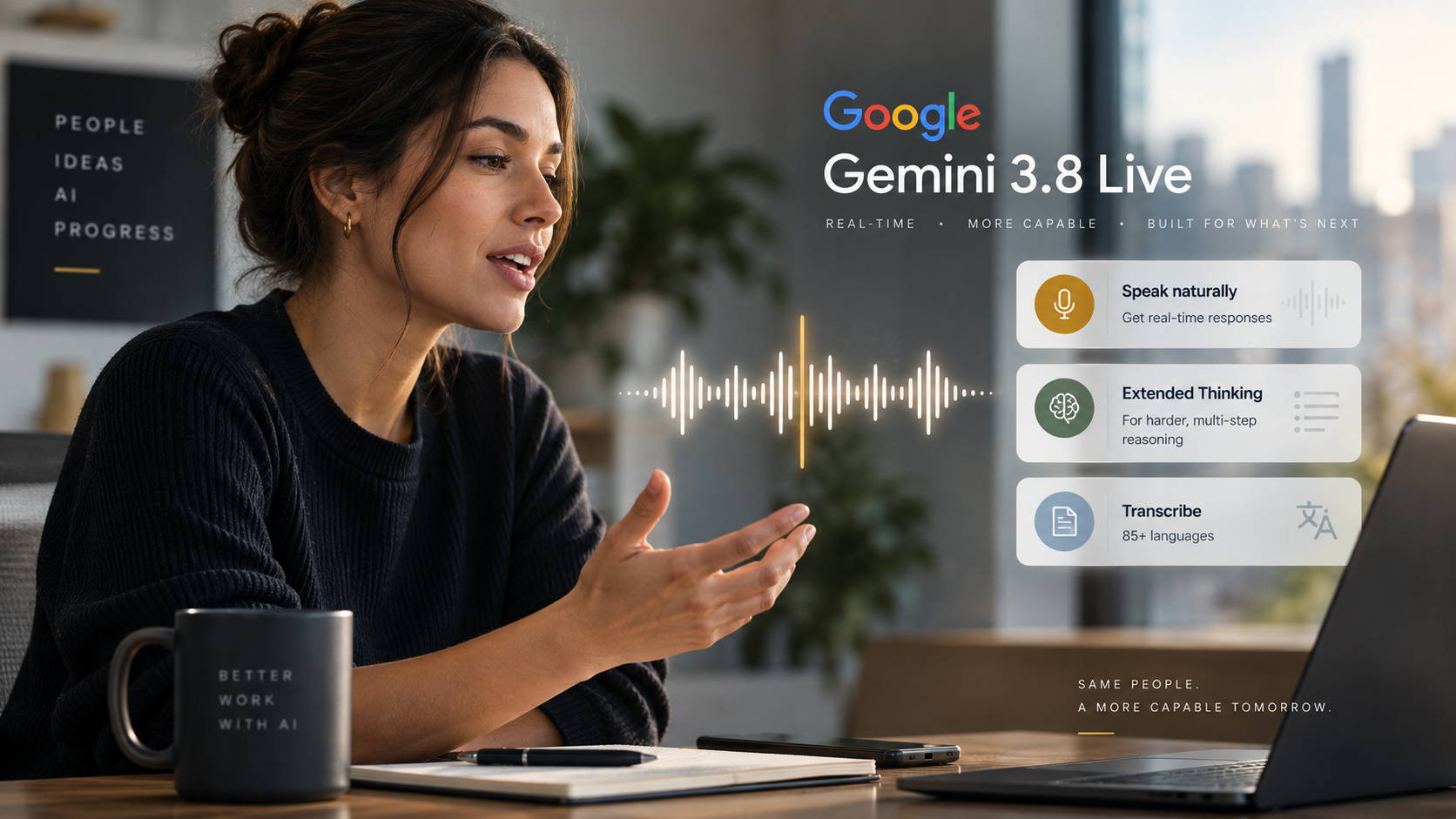
The new release includes Gemini 3.8 Live and Gemini 3.8 Live Extended Thinking, both aimed at real-time voice experiences. Google also released Gemini 3.5 Transcribe, supporting transcription across more than 85 languages.
That matters because voice changes the way people use AI.
Typing makes AI feel like software. Voice makes AI feel closer to a working partner.
That does not mean every business should rush to replace every workflow with a voice agent. But it does mean the next phase of AI adoption will not be limited to better prompts inside a browser tab.
It will increasingly happen inside conversations, meetings, support calls, field work, and real-time decisions.
What Google actually released
Google’s release has three important parts.
Gemini 3.8 Live
Built for low-latency audio-to-audio interaction, where the model can listen, respond, and keep a spoken conversation moving naturally.
Gemini 3.8 Live Extended Thinking
Designed for harder conversations that require multi-step reasoning, planning, tool use, or more complex decision support during a live interaction.
Gemini 3.5 Transcribe
A dedicated transcription model built to support speech-to-text workflows across more than 85 languages.
The bigger picture is clear.
Google is not just improving chat.
It is building the pieces for voice-first AI workflows.
Why real-time voice matters
Voice changes adoption because it removes friction.
A lot of business work does not happen neatly at a keyboard.
It happens in meetings. It happens during calls. It happens while someone is walking through a facility. It happens while a manager is driving between appointments. It happens while a technician is looking at a problem, not sitting at a desk.
Text-based AI is useful, but it still requires the person to stop, type, read, edit, and move the output somewhere else.
Voice has the potential to bring AI closer to the work itself.
A manager could talk through a staffing issue and ask AI to organize the next steps.
A customer support agent could use a voice assistant during a live call.
A field technician could verbally describe an issue and have a structured report drafted automatically.
A salesperson could finish a meeting and immediately capture follow-up tasks without opening a notebook.
This is why Gemini 3.8 Live matters.
The real opportunity is not that AI can talk.
The opportunity is that AI can participate in the workflow while the work is happening.
Extended Thinking changes the role of voice agents
Basic voice AI is helpful for simple tasks.
Answer a question. Set a reminder. Summarize a short conversation. Transcribe a meeting.
But many real business situations are not simple.
A customer issue might require checking order history, understanding policy, comparing options, and deciding whether escalation is needed.
A sales conversation might require recalling context, identifying objections, recommending next steps, and drafting follow-up.
A manager might need to reason through staffing, timing, project risk, and customer expectations at the same time.
That is where the Extended Thinking version becomes more interesting.
Responds quickly, answers simple questions, and helps with lightweight tasks.
Can pause, evaluate, use tools, plan multiple steps, and come back with a more useful answer.
That moves AI closer to operational support.
Not just, “What did they say?”
But:
“What should happen next?”
Transcription is not a side feature anymore
Gemini 3.5 Transcribe may sound less exciting than a new live reasoning model, but for many organizations, transcription is where the business value starts.
Every organization has conversations that disappear.
Sales calls. Client meetings. Support calls. Internal planning sessions. Training conversations. Field updates. Leadership discussions.
People may take notes, but those notes are inconsistent. Important details get missed. Follow-up tasks depend on memory. Customer insights stay trapped inside calls.
A strong transcription layer changes that.
Once conversations become clean, searchable, structured text, they can feed other workflows.
Meeting notes can become action items.
Customer calls can become CRM updates.
Support calls can become product feedback.
Training sessions can become internal documentation.
Sales conversations can become proposal inputs.
That is not just a productivity feature.
It is workflow infrastructure.
What this means for businesses
The practical lesson is not “switch everything to Gemini.”
The practical lesson is that AI is becoming more embedded in the moments where work already happens.
For business leaders, the question should not be:
“Should we use the newest voice model?”
The better question is:
“Where does conversation already create work inside our organization?”
That is where voice AI may matter most.
Start with workflows like customer support calls, sales discovery calls, internal meetings, training sessions, field reporting, client intake, post-meeting follow-up, service documentation, and knowledge capture.
These are not exotic use cases.
They are normal business activities where information is spoken, decisions are made, and follow-up work is created.
If AI can help capture, structure, reason through, and route that work, then voice becomes more than a convenience.
It becomes part of the operating system.
The risk: treating voice AI like another tool
There is a familiar trap here.
A new model launches. People get excited. Teams test it. Someone shares a demo. Leadership asks how the company can use it.
Then the organization buys access before deciding where it fits.
That is how AI adoption stalls.
Voice AI will not create value just because it sounds more natural.
A voice agent that is not connected to a workflow is still just another interface.
The real value comes when voice is tied to a specific business process, a clear user need, approved data access, defined handoffs, measurable outcomes, and governance around what the AI can and cannot do.
Without that structure, real-time AI becomes another impressive demo that does not change the way work happens.
Where this could show up first
The strongest near-term use cases are probably not fully autonomous voice agents replacing people.
They are voice-supported workflows that reduce manual work.
Healthcare practices could use transcription and voice workflows to support intake notes, visit summaries, or follow-up documentation.
Legal and professional services firms could capture client conversations, summarize key details, and draft internal next steps while keeping professionals responsible for judgment.
Retail and e-commerce teams could use voice agents for support workflows where customer history, policy, and order data need to be combined quickly.
Manufacturing and field-service teams could use voice input for maintenance logs, safety reports, and shift summaries when typing is inconvenient.
Sales teams could turn discovery calls into structured notes, follow-up emails, CRM updates, and proposal outlines.
The pattern is the same across industries.
AI works best when it does not ask people to create a new habit from scratch.
It works best when it improves a workflow that already exists.
The bigger shift: from prompt-based AI to workflow-based AI
The first phase of AI adoption was about prompts.
Can employees write better prompts? Can they get better answers? Can they use AI to draft, summarize, brainstorm, or research?
That still matters.
But the next phase is about workflows.
Where does AI listen? Where does it reason? Where does it act? Where does it hand off to a human? Where does the output go next?
Gemini 3.8 Live and Gemini 3.8 Live Extended Thinking are part of that shift.
They show AI moving away from a static text box and closer to the flow of daily work.
That is a bigger change than it may look like at first.
Because when AI becomes conversational, real-time, and connected to tools, the question becomes less about what the model can answer and more about what part of the work it can support.
A better model raises the ceiling. A better workflow raises the floor.
Final thought
Google’s Gemini 3.8 Live release is not just about better voice.
It is another sign that AI is moving into the live moments of work: calls, meetings, service interactions, field updates, and operational decisions.
That creates real opportunity.
But the opportunity is not automatic.
The businesses that benefit will not be the ones that simply try the newest model first.
They will be the ones that know where voice, transcription, and reasoning actually remove friction from the way their people already work.
A better model raises the ceiling.
A better workflow raises the floor.
And for most organizations, that is where the real advantage begins.
Find where AI can actually support your workflow
The AI Adoption Scorecard helps identify where your organization is getting stuck, so you can focus on the right next step instead of chasing another tool.
Take the Scorecard →
AI vs. Mosquitoes: From India’s Smart Surveillance to St. Louis Solutions
AI vs. Mosquitoes: From India’s Smart Surveillance to St. Louis Solutions In Andhra Pradesh, India

AI’s Triple Threat: Your Playbook for the New Competitive Reality
While your competition is distracted by shiny new AI features, three tectonic shifts are quietly con

AI News and Views | April 30, 2025
Innovation tailor-made for CFOs and operations leaders By Spark AI Strategy At Spark AI Strategy, we