
Are You Using a Hammer to Do a Screwdriver’s Job?
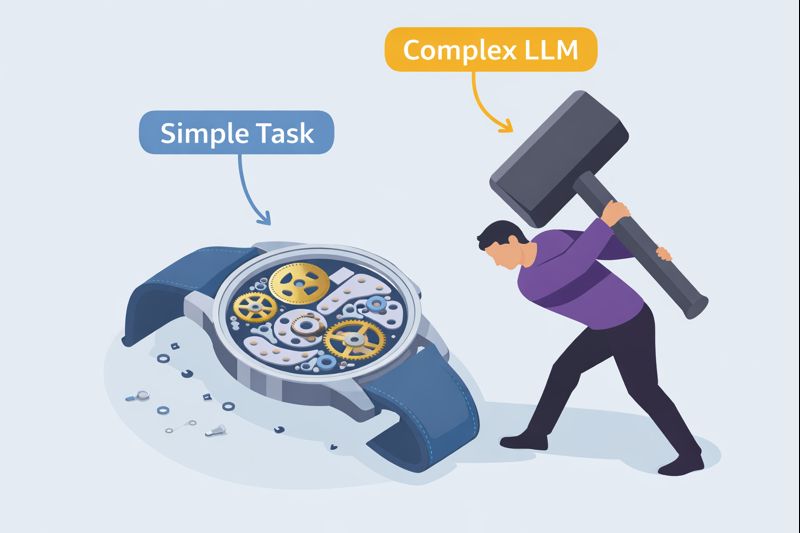
Not all AI models are created equal. In the rush to adopt the most powerful, most talked-about large language model, many companies are making a simple but costly mistake: they’re using a hammer for a job that needs a screwdriver. They default to the most powerful, and therefore most expensive, model for every single task, from summarizing meeting notes to drafting a simple email.
This “one-size-fits-all” approach is incredibly inefficient. I recently worked with a client whose marketing team was using the most advanced (and highest-priced) AI model to generate social media post variations. They were burning through their budget without realizing a faster, much cheaper model could have produced the same quality results for that specific task.
Choosing the right AI for the right job is the next level of strategic adoption. It’s about moving from “Are we using AI?” to “Are we using AI smartly?”
- Map Tasks to Tiers: Not every task requires a genius-level AI. Categorize your business needs. Does this task require complex, multi-step reasoning, or is it a straightforward summarization or classification task?
- Consider Speed and Cost: For many business applications, the speed of the response is more important than its nuance. Faster, less complex models are often better for real-time applications and are significantly cheaper to operate at scale.
- Test and Evaluate: Don’t just follow the hype. Run a simple bake-off. Give the same five business tasks to three different models and compare the results on quality, speed, and cost. The answer will often surprise you.
Using the most powerful AI for everything is like driving a race car to the grocery store. It’s impressive, but it’s an expensive and inefficient way to get the job done.
Overwhelmed by the AI marketplace? We provide strategic advisory to help you navigate licensing decisions and choose the right models for the right jobs.

From Prediction to Protection: AI’s New Role in Saving Lives
Beyond the headlines of corporate efficiency and market disruption, artificial intelligence is quiet

Imagine if you could gather the world’s greatest minds — not in a boardroom, but in your AI.
Why generic AI fails to deliver true insight—and how a human-centered approach to AI delivers meas

Your $150K AI Licenses Are Gathering Dust. What Do You Do Now?
Let’s be honest about your AI investment. Six months ago, you made the right call and purchase